Editing support that meets you where you are.
Every manuscript—and every writer—needs something a little different. Maybe you need help seeing the big picture. Maybe the story is working, but the sentences aren’t quite singing yet. Maybe you’re almost ready to publish and want one last careful set of eyes. Or maybe you simply know something isn’t working and you’re not sure what kind of help to ask for.
You don’t have to diagnose your manuscript before you contact me. We can figure that out together.
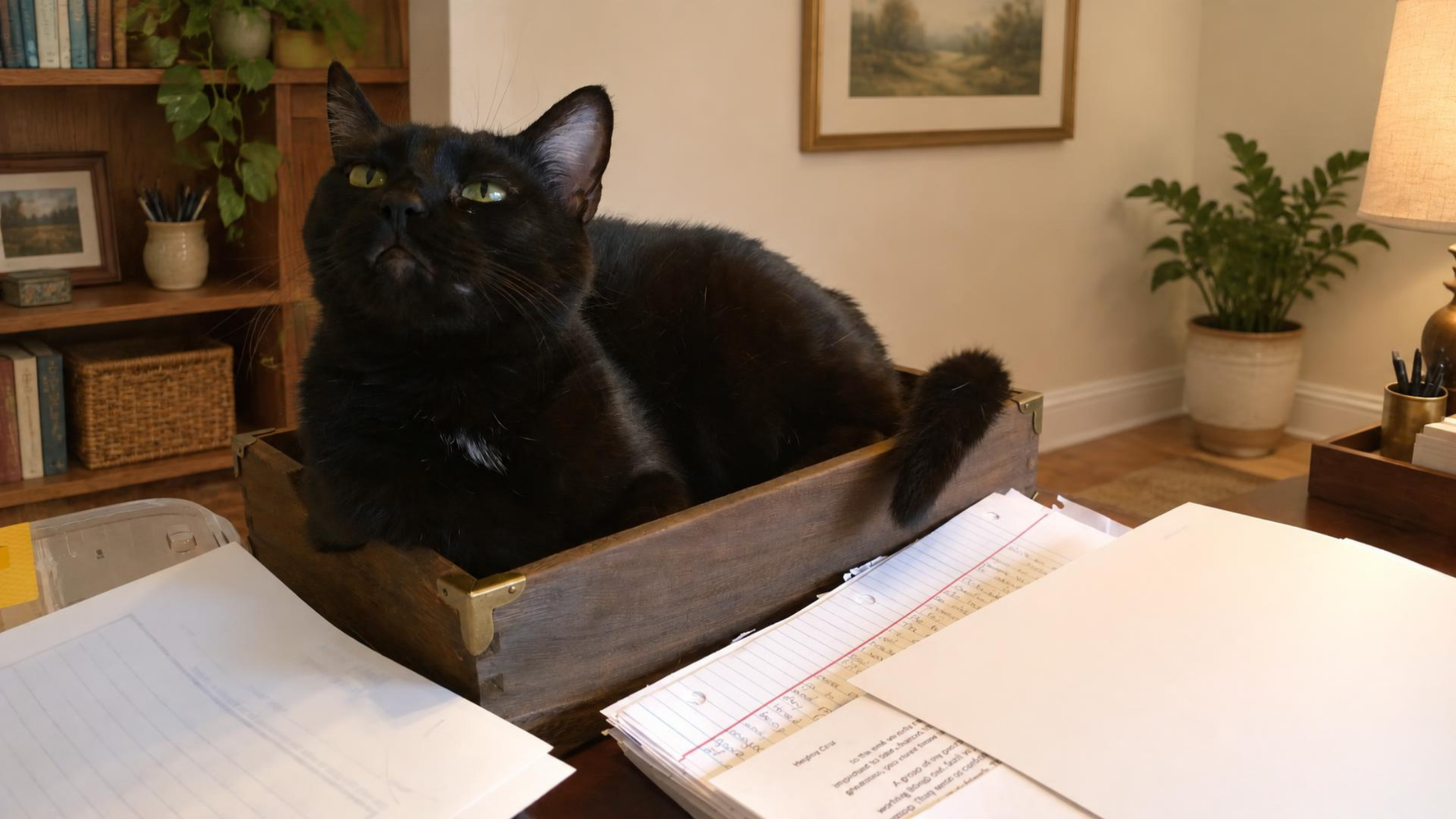
You’ll get only respect and collaboration from me. I apologize in advance for my cat Shadow, however, who absolutely will judge your writing, your fashion sense, and all your life choices.
What does your manuscript need right now?
You may already know exactly what you’re looking for, or you may only know where the frustration is showing up. These are some of the ways I can help, and we can always tailor the approach to your project.
Before we choose a service: Before I recommend a service or prepare a quote, I usually take a closer look at the project. For line editing and copyediting, that often means a complimentary sample edit of up to 1,000 words. For developmental editing, writing coaching, or projects where the right next step isn’t clear, a complimentary 20-minute conversation may be more useful.That gives me enough context to understand what your project actually needs and gives you a chance to see whether working together feels right.
DEVELOPMENTAL EDITING
Step back and see the whole story.

Developmental editing looks at the big picture: how the pieces of your manuscript work together to create the experience you want your reader to have. We’ll look at plot and structure, character development, pacing, point of view, theme, worldbuilding, emotional stakes—and the connections among them.
The goal isn’t to reshape your story into the one I would write. It’s to understand what you’re trying to create, identify what’s already working, and help you see where the manuscript could better fulfill its potential.
Developmental editing may be a good fit if:
- You’ve completed a draft, but something isn’t working the way you hoped.
- You’re wrestling with plot, pacing, character arcs, stakes, structure, or worldbuilding.
- You want thoughtful, candid big-picture feedback before moving into sentence-level editing.
You don’t need to diagnose your manuscript before you reach out. Tell me what you hoped it would become. We can start there.
What to expect
Developmental editing includes a close read of your manuscript, detailed in-manuscript comments, and an editorial letter addressing the big-picture strengths, concerns, and possibilities I see.
Pricing: A typical full-manuscript developmental edit runs about $1,500–$2,500, depending on manuscript length, complexity, and the depth of feedback needed.
Before I prepare a quote, I’ll learn more about your manuscript, where you are in the process, and what you’re hoping to accomplish. That gives me enough information to recommend the right level of support and provide a quote based on the project you actually have—not an arbitrary package.
Line editing moves in closer, working at the sentence and paragraph level to strengthen clarity, flow, rhythm, word choice, tone, and emotional impact. We’ll look for places where the language feels awkward, repetitive, vague, overwritten, or simply not quite as effective as the idea behind it.
The goal isn’t to make every sentence sound like something I would write. It’s to help your prose communicate more clearly and powerfully while preserving the voice, personality, and choices that make the writing yours.
Line editing may be a good fit if:
- Your story is structurally sound, but the prose still feels uneven, awkward, repetitive, or flat in places.
- You want stronger clarity, rhythm, imagery, and word choice without sacrificing your natural voice.
- You’re happy with the big-picture shape of the manuscript and are ready to focus on how the story is told sentence by sentence.
You don’t need to know why a passage isn’t landing. If the words on the page aren’t quite creating the effect you hear in your head, that’s something we can work on together.
LINE EDITING
Shape every sentence without losing your voice.

What to expect
Line editing includes a close, sentence-by-sentence read of your manuscript with suggested revisions and comments directly in the document using tracked changes in Microsoft Word. I’ll focus on clarity, flow, rhythm, word choice, tone, and consistency while preserving your voice and leaving final decisions in your hands.
Pricing: A typical full-manuscript line edit runs about $1,500–$3,000, depending on manuscript length and the amount of revision the prose needs.
Before quoting a new project, I’ll usually complete a complimentary sample edit of up to 1,000 words. That lets me get a realistic sense of the manuscript and the time the work is likely to require and gives you a chance to see how I approach your prose before either of us commits to the full project.
COPYEDITING
Polish the details without sanding away your voice.

Copyediting is the precision pass: a careful review of grammar, punctuation, usage, syntax, spelling, consistency, and other details that can distract readers or create confusion. I’ll also watch for continuity problems, inconsistencies in names, and other manuscript-specific details.
This isn’t about enforcing arbitrary rules or making your writing sound artificially “correct.” Good copyediting supports clarity and consistency while respecting intentional choices, character voice, dialect, genre conventions, and the way you use language.
Copyediting may be a good fit if:
- Your story and prose are largely where you want them, and you’re ready for a careful technical pass.
- You want help catching inconsistencies, grammar and punctuation problems, awkward constructions, and distracting errors.
- You’re preparing the manuscript for publication, submission, or proofreading and want the text clean and consistent first.
You don’t have to know whether something is a “rule” or a stylistic choice. That’s part of my job—and when more than one choice works, I’ll help you understand the options rather than pretending there’s only one right answer.
What to expect
Copyediting includes a careful, line-by-line review of your manuscript using tracked changes and comments in Microsoft Word. I’ll correct errors, flag possible inconsistencies or ambiguities, and query anything that needs your judgment rather than silently making a choice that could affect your meaning or voice.
I’ll also create a style sheet recording manuscript-specific decisions—names, places, capitalization, spelling, hyphenation, numbers, dates, terminology, and other details—so those choices remain consistent throughout the book. For most book-length projects, I use The Chicago Manual of Style and Merriam-Webster as my primary references unless your project calls for something different.
Pricing: A typical full-manuscript copyedit runs about $900–$1,800, depending on manuscript length and the condition of the text.
For new projects, I’ll usually begin with a complimentary sample edit of up to 1,000 words. That helps me estimate the level of attention the manuscript needs so I can give you a more accurate quote, while also giving you a chance to see what my edits and comments look like on your own work.
Writing coaching is for the parts of the writing process that don’t fit neatly into an editing category. Maybe you’re still finding the story. Maybe you’ve written yourself into a corner, lost momentum halfway through a draft, or accumulated so many possibilities that choosing one feels impossible. Maybe you know what you want to write but can’t quite figure out how to get from the idea in your head to words on the page.
Coaching gives us room to talk it through. We might brainstorm possibilities, untangle a plot problem, look closely at a stubborn scene, explore character motivations, talk craft, build a manageable plan, or troubleshoot the writing process itself. Sometimes what you need isn’t someone to edit the work—it’s another creative brain beside you while you figure out what comes next.
Writing coaching may be a good fit if:
- You’re stuck, overwhelmed, or unsure what your next step should be.
- You want thoughtful feedback or brainstorming help without committing to a full-manuscript edit.
- You could use support, accountability, or another writer to help you sort through the possibilities and find the path that feels like yours.
You don’t have to show up with a polished draft—or even a coherent question. Bring the half-formed idea, the scene that refuses to cooperate, the impossible decision, the pile of notes, or the blinking cursor. We’ll start with what you have.
WRITING COACHING
Bring the stuck places. We’ll find a way forward.


What to expect
Writing coaching is a one-on-one conversation shaped around whatever you need most that day. You can come with a specific craft question, a scene you want to untangle, an outline full of holes, seventeen competing ideas, or simply, “I’m stuck and I don’t know why.” If there are pages, notes, or other materials you’d like me to see beforehand, you’re welcome to send them along.
During our session, we’ll talk, brainstorm, ask questions, test possibilities, and follow the threads that seem most useful. You’ll leave with a clearer sense of what you want to try next—not a prescribed answer you’re obligated to follow.
Pricing: Writing coaching is intentionally flexible, because writers—and writing problems—rarely arrive in tidy one-hour packages.
We’ll usually start with a complimentary 15–20 minute chat about what you’re working on, where you’re feeling stuck, and what kind of support might be useful. From there, we can decide what makes sense.
A focused one-on-one writing session will typically run about $125–$150. We might brainstorm possibilities, untangle a plot or character problem, work through a difficult scene, talk craft or revision, or simply figure out what your next step is.
If you’d like me to read material beforehand, a manuscript-review session will typically run about $175–$250, depending on how much material you’d like me to review and what you want to accomplish together.
For longer-term or ongoing coaching, we’ll work out an arrangement based on your project, your goals, and the kind of support that would actually be useful to you.